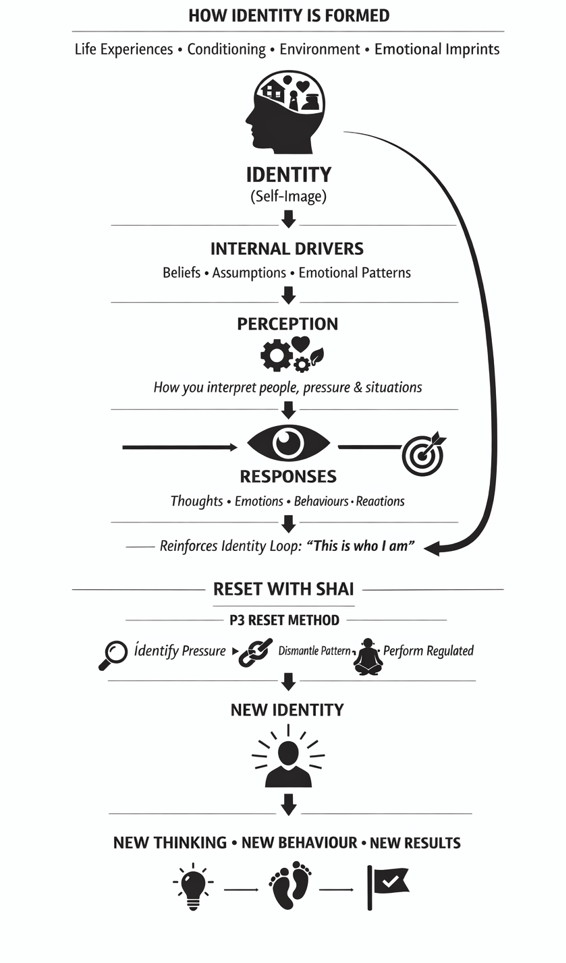
Identity Architecture: How Identity is Formed
Identity Theory suggests that behaviour is not random but is generated from our underlying sense of identity — the internal roles and self-concepts we unconsciously adopt (e.g., “I am the responsible one,” “I can’t disappoint,” “I’m not enough”). These identity positions form an “identity architecture,” like a structure built from core beliefs at the foundation, meaning patterns as the framework, and behaviours and emotional responses as the outward expression.
Simply put: What you believe about yourself at the deepest level shapes how you interpret life, and that then drives how you behave and feel This system silently shapes decision-making, emotional regulation, stress responses, relationships, and performance.
When identity is outdated or formed under pressure, behaviour becomes effortful and relies on willpower, often leading to repeating patterns despite new strategies. At the core sit deeper subconscious identity beliefs (“I am…”, “People like me…”), which the nervous system treats as fact and actively protects by filtering reality to maintain consistency. Because of this, change at the behavioural level alone is temporary; lasting transformation occurs when the identity belief is updated, allowing behaviour to reorganise naturally and align without force. This is where “Reset with Shai” comes in.