
The P3 Reset Method
Pressure → Pattern → Performance
Most people try to fix their performance without ever looking at what’s driving it.
The P3 Reset Method works backwards — we start with the pressure you can feel, trace it to the pattern running underneath it, and then performance naturally transforms.
So, your performance in life, work, and relationships becomes natural rather than forced.
Because performance is never the real problem. It’s the outcome of something deeper.
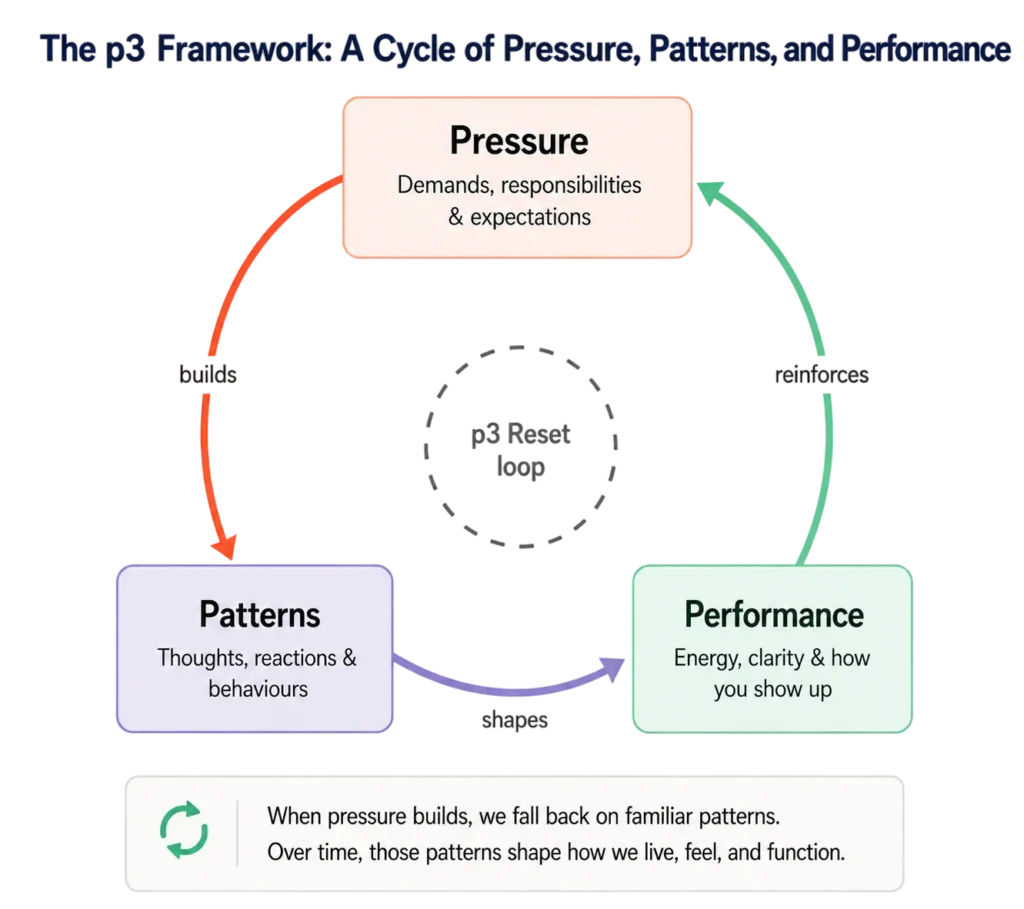
Pressure
What’s weighing on you right now
This is the entry point — what the client can actually feel and name. It’s the stress, the burnout, the anxiety, the overwhelm, or the life transition that feels hard to hold
What this often sounds like:
- “I’m exhausted but I can’t switch off”
- “I’m dreading going to work but I don’t know why”
- “I’ve just changed roles/careers and I feel completely lost”
- “Everything looks fine on paper but I feel like I’m drowning”
Most people stay here.
They manage pressure with willpower, caffeine, productivity hacks, or pushing through.
It works — until it doesn’t.
Because pressure is not the root issue. It’s the signal
Pattern
The subconscious programme underneath the pressure
This is the root. The old belief, the nervous system response, the childhood decision that’s been running silently in the background and creating the pressure in the first place. Patterns are the unconscious beliefs, emotional conditioning, and nervous system responses that quietly shape how you think, feel, and behave under pressure. They often formed early — through experience, environment, repetition and emotional imprinting — and now run automatically in the background.
What this can look like:
- Overworking and never switching off → “My worth equals my productivity.”
- Anxiety in meetings → “It’s not safe to be seen or wrong.”
- Over-giving until burnout. Always saying yes until you snap → “I have to earn my place.”
- Repeating toxic or draining environments → “This is what I deserve or can expect
Until the pattern is identified and updated, the pressure keeps coming back. You can take holidays, change jobs, relationships, goals, even lifestyle — and still end up back in the same emotional experience. Because the system running it hasn’t been updated.
Performance
How you show up when the pressure shifts and the patterns reset
This isn’t just work performance — it’s how you perform as a human. It’s how you think, decide, relate, and respond to life. Your relationships, your energy, your decision-making, your confidence, your sense of self.
What this looks like after the reset:
- Making decisions from clarity instead of fear
- Setting boundaries without guilt or anxiety
- Showing up in high-pressure situations with a calm presence
- Increased emotional capacity and resilience
- Grounded. Finally feeling like yourself again — not a coping version of you
This is where performance becomes sustainable. Not because life gets easier — but because your internal system stops working against you.
Why the P3 Reset Works Differently?
Conventional Coaching
Skill & awareness focused
Works at conscious level
Slower behavioural integration
Surface confidence shifts
Change fragile under pressure
P3 Reset
Pattern & stress response focused
Works beneath conscious resistance
Faster integration through neuroplasticity (4x faster)
Identity-level recalibration
Change sustained under pressure
The Science Behind It
- Pressure activates patterns in the nervous system
- Patterns are reinforced neural pathways (automatic responses)
- Performance shift: New responses & wiring create new pathways
Supporting Evidence
- Reduced stress response and improved cognitive clarity. Protect your brain from stress
Harvard Medical School / Harvard Health Publishing
Harvard Health Publishing (2021)
Ressler, K. & Goldstein, J. Protect your brain from stress
https://www.health.harvard.edu/mind-and-mood/protect-your-brain-from-stress
- Emotional regulation and resilience are key predictors of future-ready leadership
World Economic Forum
World Economic Forum (2023/2024)
Future of Jobs Report
https://www.weforum.org/reports/the-future-of-jobs-report-2023/
Stress reduction (systematic review of RCTs)
Fisch, S., Brinkhaus, B. (2017)
Hypnosis in patients with perceived stress – a systematic review
BMC Complementary Medicine and Therapies, 17:323
https://doi.org/10.1186/s12906-017-1806-0
Findings:
9 RCTs included (n = 365 participants)
6/9 studies showed significant reductions in perceived stress
Some studies also measured immunological/physiological stress markers
Conclusion: promising effects, but methodological limitations exist
Anxiety reduction (meta-analysis)
Valentine, K.E., Milling, L.S., et al. (2019)
The efficacy of hypnosis as a treatment for anxiety: a meta-analysis
International Journal of Clinical and Experimental Hypnosis
https://doi.org/10.1080/00207144.2019.1613863
Findings:
15 studies, 17 trials (RCTs and controlled designs)
Hypnosis produced significant reductions in anxiety symptoms. Effects were comparable to other established psychological interventions in many studies
Hypnosis as a non-pharmacological intervention for invasive medical procedures – A systematic review and meta-analytic update.
Physiological stress response (medical procedures meta-analysis).
Objective biomarkers (heart rate, blood pressure, cortisol-related proxies)
Lang, E.V. et al. / Systematic review evidence (multiple RCTs synthesised)
Hypnosis for anxiety, pain, and physiological stress in medical procedures
Findings:
Hypnosis significantly reduces:
- anxiety (SMD ≈ -0.43)
- pain (SMD ≈ -0.35)
- physiological stress markers (heart rate, blood pressure)
This systematic review and meta-analysis support the integration of hypnosis as a valuable, non-pharmacological intervention in the management of anxiety and pain during invasive medical procedures. Given its demonstrated benefits and low-risk profile, clinical hypnosis should be considered as part of routine standard-of-care to enhance patient experiences and reduce reliance on pharmacological interventions.